A dental implant looks simple once it’s restored with a crown, but the planning beneath the final result is highly detailed. The implant has to sit in bone at a position that can support the future restoration while respecting the surrounding anatomy. If you’ve been thinking about getting dental implants in Murrieta, you may be surprised by how much angle and depth affect the way everything comes together.
All of that planning supports the part you do see, which is the finished tooth. The implant underneath provides its foundation, which is why precise dental implant placement matters for a result that feels comfortable, functions properly, and works with the rest of your mouth over time.
That starts with choosing an angle that works with the future tooth.
Why does the angle of a dental implant matter?
An implant becomes the foundation for the restoration above it, so its angulation influences where the crown or bridge will emerge and how naturally it can function with the surrounding teeth.
The implant should support the future tooth
The implant’s position in the bone should give the restoration a solid foundation while allowing the crown to sit where it belongs in your bite and smile. That balance is what ideal implant positioning is about. The available bone matters, along with the shape and location of the final restoration.
When both are planned together, the fixture is better positioned to support a crown that looks natural and functions comfortably. The location of a missing tooth changes the implant plan because front and back teeth have different functional and esthetic demands. The fixture needs to be positioned with those differences in mind.
The angle affects the whole structure of the restoration
Once the fixture is in place, its angle influences how the restoration above it comes together. The crown or other prosthetic work needs to sit naturally in the bite and handle everyday chewing comfortably. Angulation also affects details patients never see.
With screw-retained restorations, for example, the direction of the fixture helps determine where the screw-access opening ends up. In a visible area, that can influence the final design. The proposed position is therefore evaluated in three dimensions before surgery so the chosen direction works with the surrounding bone and the way the final tooth will function.
What happens if a dental implant is placed at the wrong angle?
 Even a relatively small change in direction can affect how the final tooth has to be designed. The farther the placement is from the intended position, the more the final tooth needs to be adjusted.
The crown may need to compensate
When a fixture sits at an unfavorable angle, the abutment or crown may need to be shaped differently to bring the visible tooth back into position. Some discrepancies can be managed with angled components, while larger ones leave fewer restorative options.
The gumline can also be affected. If the crown has to make a noticeable correction as it rises from the fixture, the area can become harder to keep clean and less natural in shape. Digital planning helps identify these issues before surgery, while a surgical guide can help carry the intended position into the procedure more accurately.
Spacing has to be carefully planned
Placement depends on how much room is available in that part of the jaw. If more teeth need to be replaced, the surgical approach changes because the surgeon has to account for the space between multiple fixtures. The available room is assessed against established dental implant space requirements.
A commonly used guideline is about 1.5 mm between the fixture and a neighboring natural tooth, with roughly 3 mm between two adjacent fixtures. The ideal distance between implant and tooth still depends on local anatomy. Root position and available bone width help determine how much room the surgeon has to work with.
How is the proper depth for an implant determined?
There isn’t one depth measurement that works for every case. The vertical position is chosen after looking at several features of the treatment area.
- Available bone: Height and width help determine how much room is available for secure placement.
- Nearby anatomy: The mandibular canal, nerves, and maxillary sinus can limit how far the fixture can safely extend.
- Soft-tissue thickness: Gum tissue affects how the future tooth will emerge once restored.
- The planned tooth: The final crown or prosthesis influences how deep the fixture should sit beneath the gumline.
With 3D implant planning, the surgeon can examine the intended site from multiple views and evaluate bone height, width, and nearby anatomy before surgery. Those measurements show whether the existing bone can support the planned placement and whether bone grafting or another procedure may be needed first.
The scan also helps the surgeon evaluate implant distance from vital structures. In the lower jaw, the mandibular canal and its nerve affect the available space. In the upper posterior jaw, the maxillary sinus can limit vertical bone height.
Depth is planned around the future tooth
The fixture needs to sit at a level that allows the future tooth to emerge through the gum tissue with a natural contour. Soft-tissue thickness also affects how the part below the gumline connects with the visible tooth above it.
Replacing a single tooth differs from restoring a full arch because each case places different demands on the position and role of the fixtures. For full-arch treatment, the number of fixtures can vary, with All-on-4 and All-on-6 falling under the broader All-on-X approach. Their layout depends on the available anatomy and the prosthesis they will carry.
What happens if a dental implant is placed too deep?
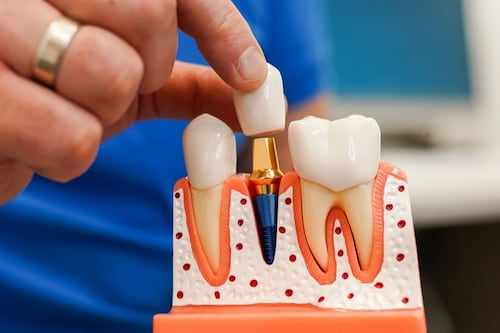 “Too deep” means the fixture sits farther into the jaw than is appropriate for that site.
That can create several practical problems:
- The crown may be harder to shape naturally. More distance between the fixture and visible tooth can make a smooth contour through the gum tissue harder to achieve.
- Cleaning may become more difficult. A deeper position can create more space beneath the gumline where plaque is harder to reach.
- Nearby nerves may be at greater risk. In the lower jaw, excessive depth can bring the fixture closer to the inferior alveolar nerve.
- Available bone can become more limited. The surgeon still has to stay clear of nearby structures.
The fixture needs to sit securely in the jaw without crowding the visible tooth or nearby tissues.
Who can I trust for carefully planned dental implants in Murrieta?
Dr. Dmitry Tsvetov, a board-certified oral and maxillofacial surgeon, plans every case at Temecula Center for Dental Implants, from single teeth to full arches. Patients from Murrieta, including those near Murrieta Hot Springs, can have their anatomy evaluated with advanced imaging before the surgical plan is finalized
If you’re ready to replace missing teeth with a plan built around precision from the start, contact our office today to schedule your consultation.